Glu-C, Sequencing Grade
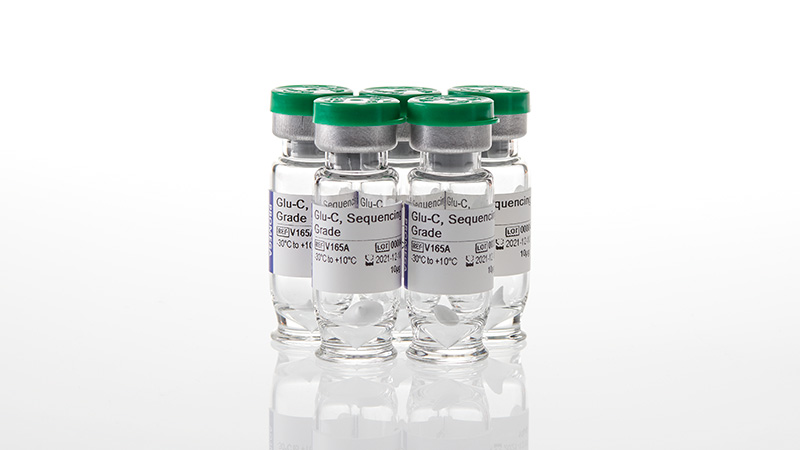
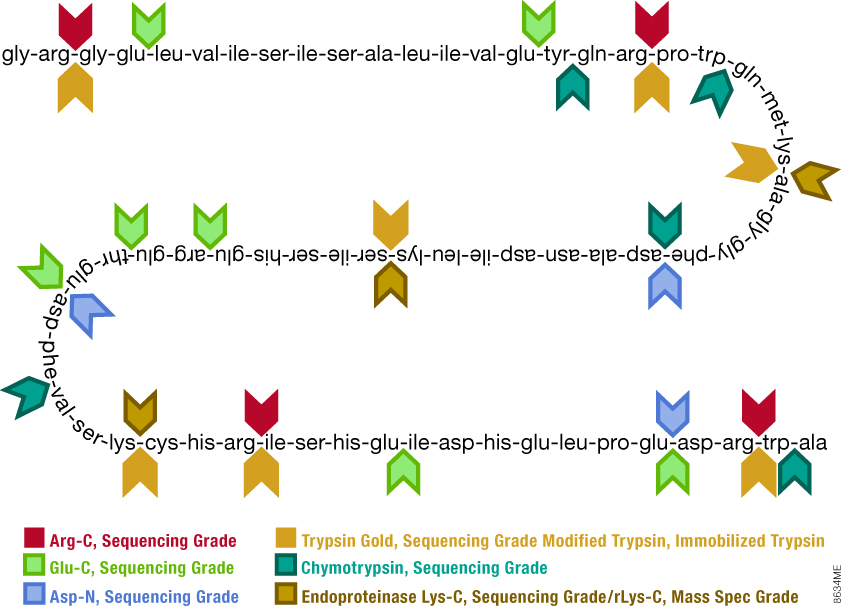
Cleaves at the C-Terminus of Either Aspartic or Glutamic Acid Residues
- Optimal activity at pH 4–9
- Ammonium and phosphate buffers can affect cleavage; see details in product information
- Suitable for in-solution digestion; not recommended for in-gel digestion

Catalog Number:
Size
Catalog Number: V1651
This sequencing grade serine protease (S. aureus V8) specifically cleaves at the C-terminus of either aspartic or glutamic acid residues. In ammonium bicarbonate and ammonium acetate the enzyme specificity is higher at the glutamic residues. In phosphate buffers cleavage occurs at the aspartic and glutamic residues. Glu-C activity is optimal in the pH range of 4.0–9.0. This sequencing grade enzyme can be used alone or in combination with other proteases to produce protein digests for peptide mapping applications or protein identification by peptide mass fingerprinting or MS/MS spectral matching. It is suitable for digestion reactions in solution but not recommended for in-gel digestions. (S. aureus V8)
Applications- Peptide mapping
- Protein identification
Protocols
Complete Protocol
Specifications
Catalog Number:
What's in the box?
| Item | Part # | Size |
|---|---|---|
|
Glu-C, Sequencing Grade |
V165A | 5 × 10μg |
SDS
Search for SDSCertificate of Analysis
Use Restrictions
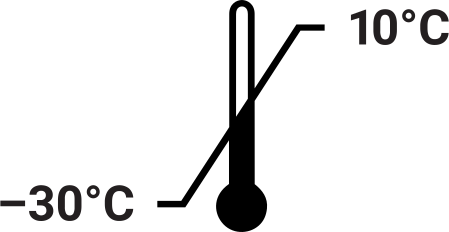
For Research Use Only. Not for Use in Diagnostic Procedures.Storage Conditions
Resources
No related resources available
Related Products
Similar Products
rAsp-N, Mass Spec Grade
Cleavage site: N-terminal of Asp. Optimal pH: 6–9.
VA1160
Lys-C, Mass Spec Grade
Cleavage site: C-terminal of Lys. Optimal pH: 7–9.
VA1170
Trypsin Gold, Mass Spectrometry Grade
Maximum digest specificity with extreme resistance to autolytic digestion.
V5280
Trypsin/Lys-C Mix, Mass Spec Grade
Increased peptide recovery, enhanced protein quantitation, improved reproducibility.
V5071, V5072, V5073